
National Sovereignty Cannot Be Imported: Lessons from Venezuela’s and Iran’s Defence Failures
Spectacular U.S. operations and failed Venezuelan and Iranian defenses should force nations to ask themselves a hard question: Can national sovereignty be outsourced? From penetrated air defenses that are based on Russian and Chinese technologies, to intelligence-driven U.S. strikes, recent events expose the limits of superpower weapons, political backing, military advising, and intelligence cooperation—and the hidden costs of dependence on foreign powers. This article examines why real security must be built at home, not bought abroad.
GENERAL TOPICSSOCIAL COMMENTARYSCIENCE & TECHNOLOGY
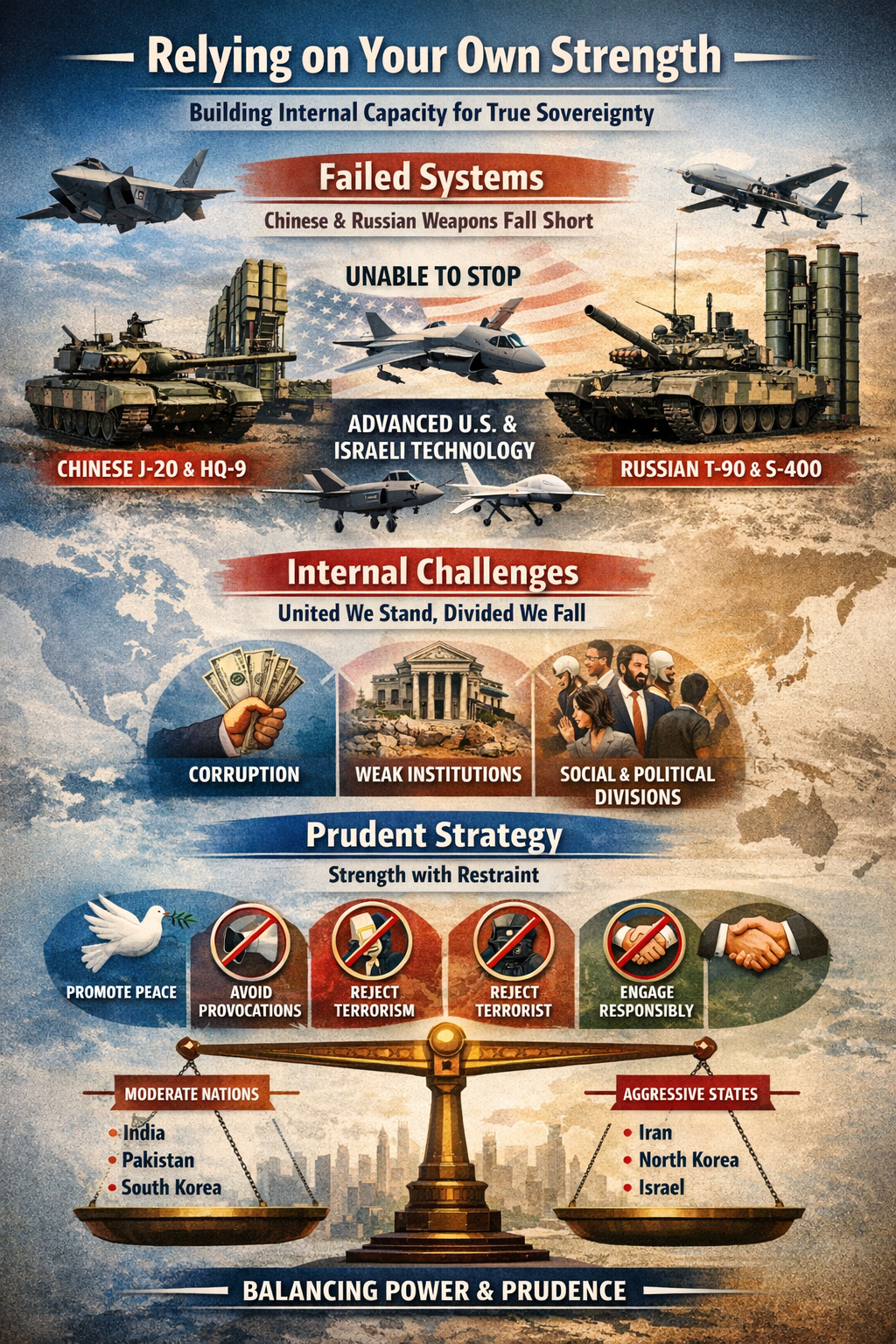
The dramatic apprehension of the Venezuelan president and his wife from inside their bedroom in a fortified presidential mansion on January 3, 2026, became an instant symbol of modern power projection. Similarly, successful strikes on Iranian nuclear facilities sent ripples through global capitals. These operations occurred despite the presence of Chinese- and Russian-supplied security and air-defense systems to Venezuela and Iran. Whatever the disputes over details, the strategic signal is clear: these Russian and Chinese systems did not prevent decisive action by adversaries possessing superior intelligence, surveillance, cyber access, and operational integration—most notably the United States and Israel.
A pattern of failure
Chinese and Russian platforms—air defenses, armored vehicles, aircraft, and missile systems—have repeatedly underperformed when confronted with advanced Western or Israeli technologies. The core reason is not merely hardware quality, but systems dependency. Modern warfare is driven by intelligence dominance: satellite coverage, cyber penetration, electronic warfare, real-time data fusion, and precision targeting. Nations that lack these capabilities cannot compensate by purchasing stand-alone platforms, no matter how formidable they appear on paper.
Why Chinese and Russian systems continue to attract buyers
Many countries continue to buy Chinese and Russian systems for rational reasons. They are cheaper, delivered faster, and come with fewer political conditions. Beijing and Moscow are willing to sell to sanctioned states, regimes facing internal legitimacy challenges, or governments seeking autonomy from Western pressure. U.S. and NATO suppliers, by contrast, impose export controls, end-use monitoring, training requirements, and political expectations. Most critically, the United States will not sell systems it cannot itself access, override, or neutralize if strategic interests diverge.
The strategic risk of relying on inferior or externally controlled technology
The problem is that cost and convenience are not the same as security. States that rely on inferior or externally controlled technologies are building defenses that may fail precisely when they are most needed. Territorial integrity cannot rest on systems that adversaries already understand, can bypass, or have repeatedly defeated in real-world conditions. Reliance on superpowers—Eastern or Western—is therefore not a durable strategy.
Internal capacity as the only sustainable path
The only sustainable alternative is internal capacity building across short, medium, and long-time horizons: domestic defense industry, secure command-and-control, professionalized forces, indigenous intelligence, and institutional resilience. External suppliers can supplement these efforts, but they cannot replace them. But no amount of imported hardware can compensate for weak institutions, endemic corruption, or deep social and political fragmentation. Internal decay ultimately negates external strength.
Strategic restraint and the avoidance of self-inflicted pressure
Equally important is strategic restraint. Nations seeking to strengthen themselves internally must avoid excessive noise-making, unnecessary threats to other nations, persistent confrontation, or the sponsorship of terrorist groups or organizations. All these invite isolation, sanctions, and preemptive pressure. India, Pakistan, and South Korea illustrate varying degrees of this restraint: serious internal capacity development combined with calibrated external behavior. Iran, by contrast, demonstrates the cumulative cost of sustained antagonism. North Korea and Israel occupy an intermediate position, pairing strong internal discipline with periodic escalation that carries both deterrent benefits and strategic risks.
The bottomline: Security is built, not bought
My conclusion is straightforward and unsentimental. Security is not bought; it is built. Imported weapons cannot substitute for intelligence superiority, institutional cohesion, or strategic discipline. Nations that mistake access to foreign systems—especially inferior ones—for sovereignty will eventually discover the limits of that illusion.


Get in touch
Nwankama Nwankama
Email is best (or, you can fill out the Contact form)
nwankama@nwankama.com


Home | About Us | Blog | Site Map | Contact Us